
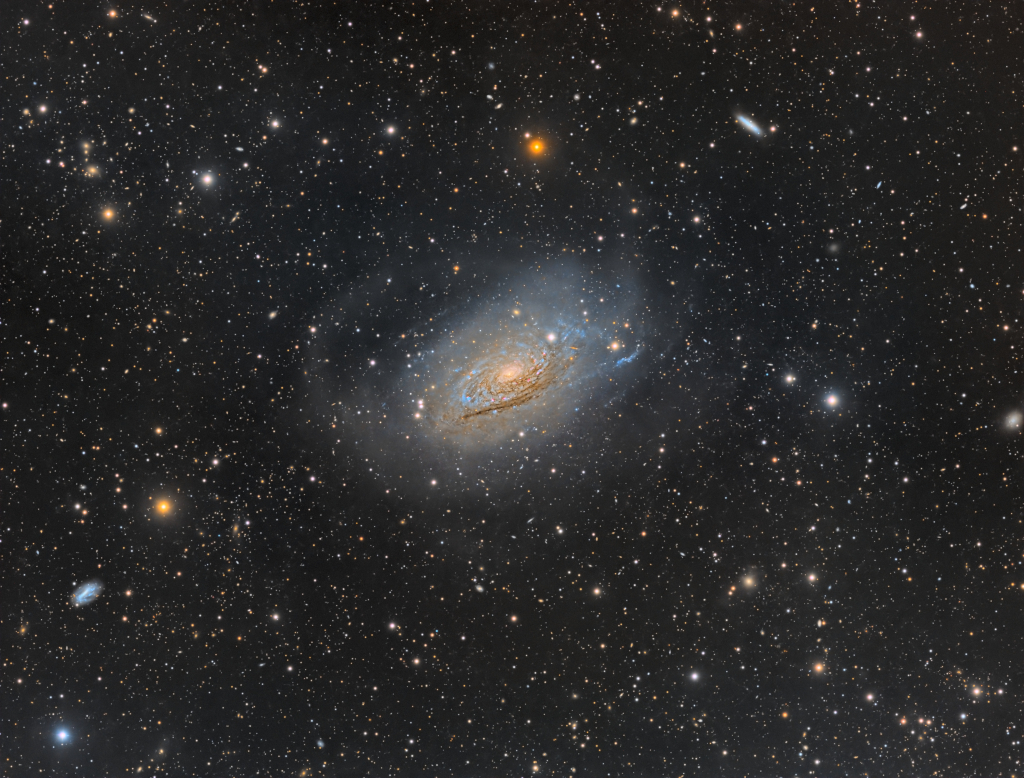
Explanation: Messier 63, a bright spiral galaxy in the northern sky, is located about 30 million light-years away in the constellation Canes Venatici. Also cataloged as NGC 5055, this majestic island universe spans nearly 100,000 light-years, making it about the size of our own Milky Way. Its bright core and majestic spiral arms earned the galaxy its popular name, the Sunflower Galaxy. This exceptionally deep exposure reveals faint loops and curling star streams extending far into the galaxy’s halo. The star streams extend nearly 180,000 light-years from the galactic center and are likely remnants of tidally disrupted satellites of M63. Other satellite galaxies of M63, including dwarf galaxies, which could contribute to M63’s star streams in the next few billion years, can be spotted in the remarkable wide-field image.
Tag Archives: Galaxy
The Curly Spiral Galaxy (M63)
Journey to the Center of the Galaxy
What lies at the center of our galaxy? In Jules Verne’s classic science fiction novel, A Journey to the Center of the Earth, Professor Liedenbrock and his fellow explorers encounter many strange and exciting wonders. Astronomers are already aware of some of the bizarre objects that exist at our Galactic Center, including vast cosmic dust clouds, bright star clusters, swirling gas rings, and even a supermassive black hole. Much of the Galactic Center is hidden from our view in visible light by intervening dust and gas, but it can be explored using other forms of electromagnetic radiation. The featured video is actually a digital zoom into the center of the Milky Way, beginning with visible-light images from the Digitized Sky Survey. As the movie progresses, the light shown shifts to dust-penetrating infrared, highlighting gas clouds recently discovered in 2013 that are falling toward the central black hole.