Tag Archives: Milky Way

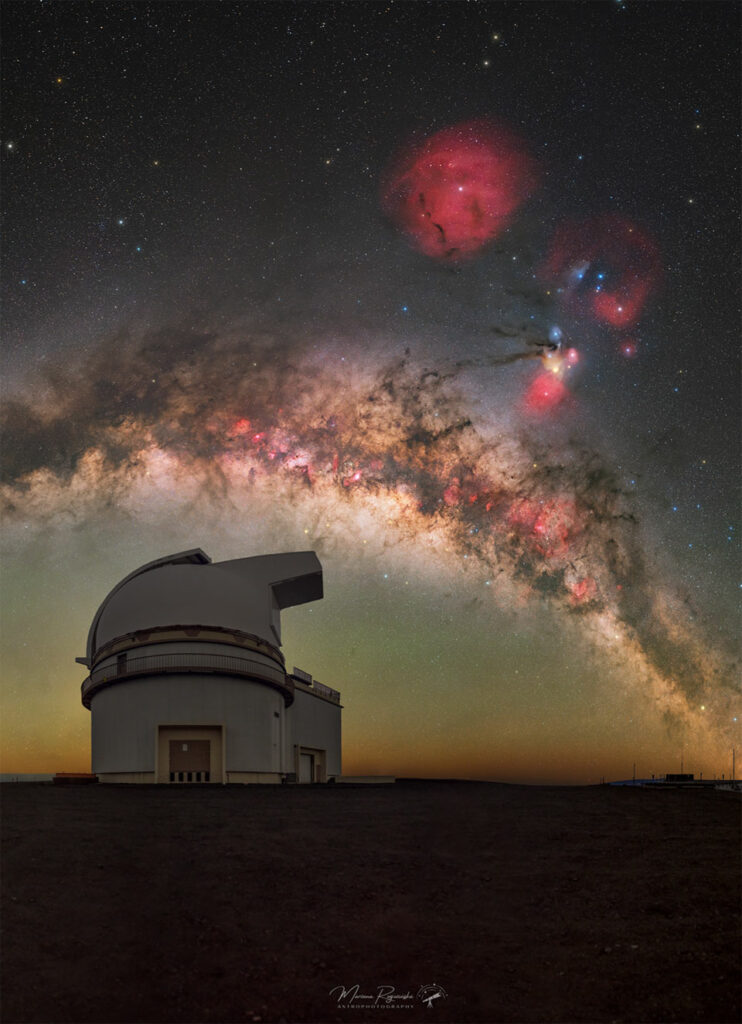
The Milky Way over Maunakea

The Milky Way Over Maunakea

Explanation: Have you ever seen the Milky Way? On a clear night in a dark location, a faint band of light becomes visible across the sky. Once your eyes have adapted to the darkness, you may be able to see the band for the first time. It may then become obvious. Then it becomes spectacular. One reason for your growing astonishment may be realizing that this fuzzy swath contains billions of stars. In the featured image, the band of the Milky Way Galaxy arcs high above the night sky. Also visible are the colorful Rho Ophiuchi clouds on the right and the red, circular Zeta Ophiuchi nebula near the top center. Taken in late February from Maunakea in Hawaii, the foreground telescope is the University of Hawaii’s 2.2-meter telescope. Fortunately, you don’t need to be near the top of a Hawaiian volcano to see the Milky Way.
NGC 6366 vs 47 Ophiuchi

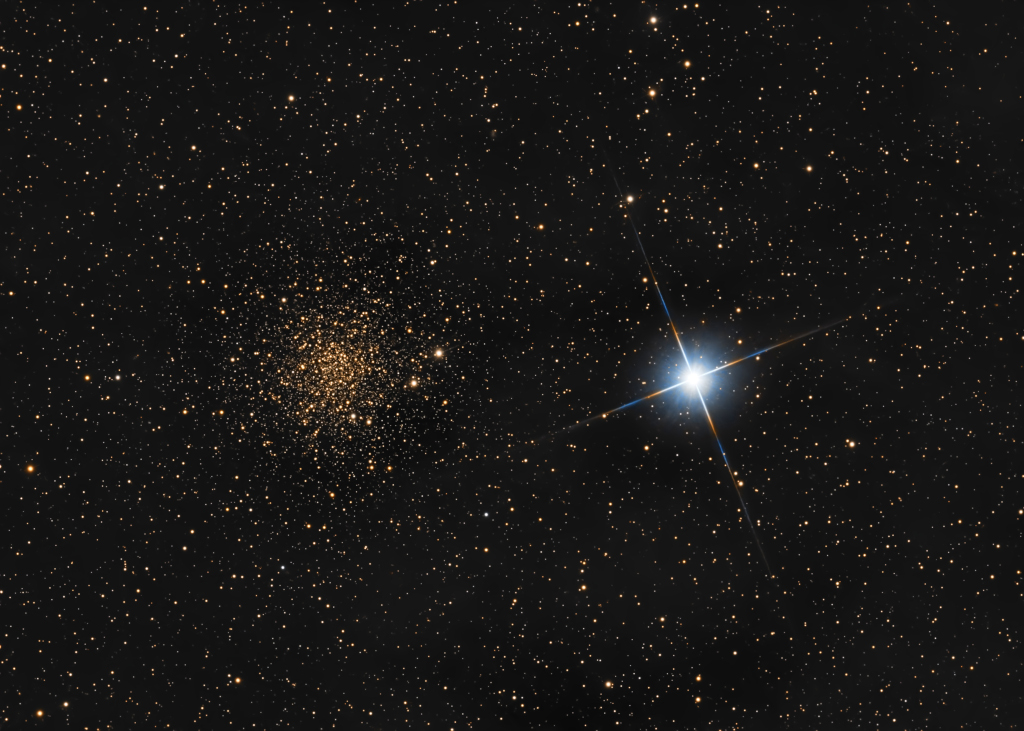
NGC 6366 vs 47 Ophiuchi
Explanation: Most globular star clusters roam the halo of the Milky Way, but the globular cluster NGC 6366 lies close to the galactic plane. Located about 12,000 light-years away in the direction of the constellation Ophiuchus, the cluster’s starlight is dimmed and reddened by interstellar dust in the Milky Way when viewed from Earth. Consequently, the stars of NGC 6366 appear golden in this telescopic image, particularly when compared to the relatively bright, blue, nearby star 47 Ophiuchi. Compared to the approximately 100,000 stars gravitationally bound in distant NGC 6366, 47 Ophiuchi is a binary star system just 100 light-years away. However, the co-orbiting stars of 47 Ophiuchi are too close together to be distinguished individually in the image.

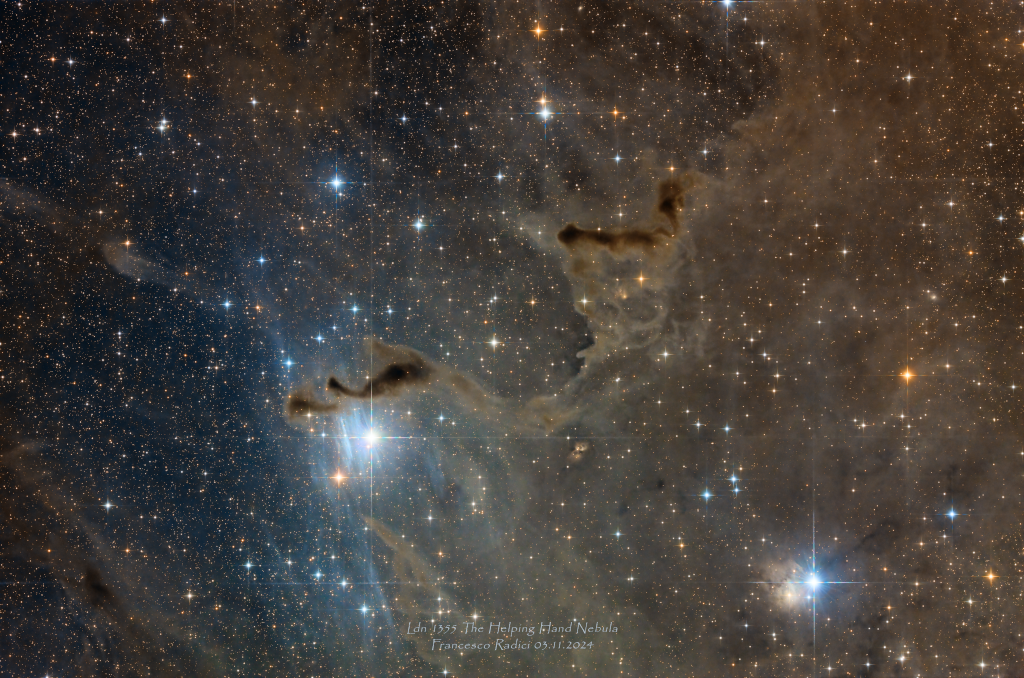
Helping Hand in Cassiopeia

Helping Hand In Cassiopeia

These dusty molecular clouds, situated in the vicinity of the Milky Way galaxy, appear to extend a cosmic helping hand. These interstellar clouds are part of a local complex of star-forming interstellar clouds, which include LDN 1358, 1357, and 1355 from the 1962 Catalog of Dark Nebulae, as compiled by American astronomer Beverly Lynds. The obscuring dark nebulae, which present a challenging target for astro-imagers, are situated at a distance of approximately 3,000 light-years from Earth. They are located towards rich star fields in the northern constellation Cassiopeia. At that distance, this deep, telescopic field of view would span approximately 80 light-years.

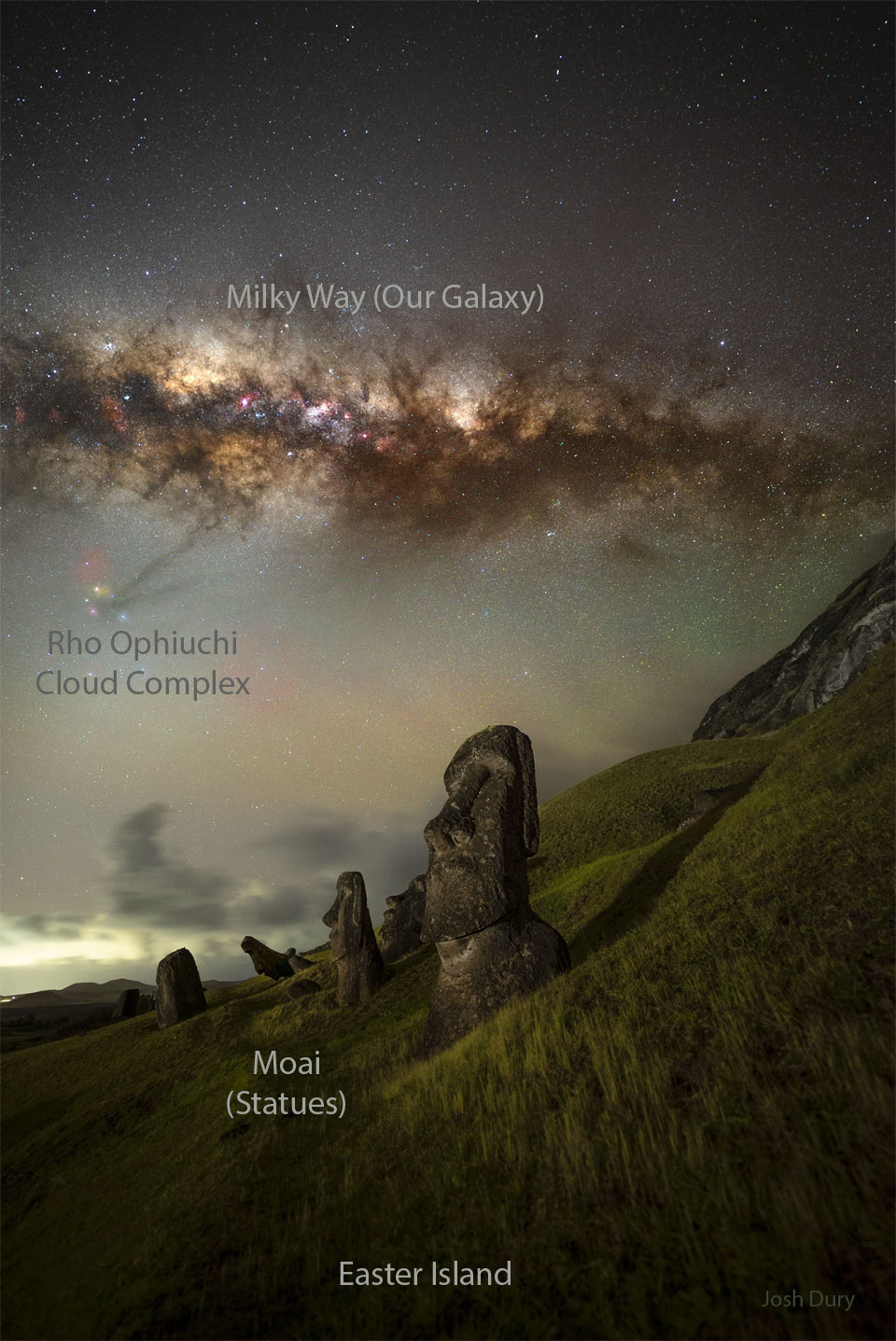
The Milky Way galaxy over Easter Island

Milky Way Galaxy Over Easter Island

What was the purpose of the construction of the statues on Easter Island? The precise reason for their construction remains uncertain. It is certain that over 900 large stone statues, collectively known as moai, exist on Easter Island. The average height of a Rapa Nui (Easter Island) moai is approximately 20 meters, which is over twice the average height of a person. Additionally, the average mass of a moai is over 200 times greater than that of an average person. It is hypothesized that the anomalous statues were constructed approximately 600 years ago in the likeness of local leaders of a flourishing and archaic civilization. Rapa Nui has been designated a World Heritage Site by UNESCO. The accompanying illustration depicts some of the stone colossi imaged last month under the central band of our Milky Way galaxy. The discovery of previously unknown moais persists.